




What Is a Seat Slider in a Chair? How Seat Depth Adjustment Really Works
Two people can sit in the same chair and leave with opposite opinions, and the reason is often a part nobody names: the short pair of rails under the seat pan that moves it forward and backward. A seat slider is the adjustment that matches seat depth to the length of a user's thigh, and it is the one feature that separates a chair that fits one body from a chair that fits a room full of them. This guide explains what the part does, the four ways it is built, how its lock behaves under load, and where a chair-grade slider stops and a vehicle-grade rail begins.
Key Takeaways
A seat slider moves the seat pan forward and backward only; it is separate from seat height, which is set by the gas spring, and from back angle, which is set by the recliner.
Chair sliders commonly offer 50 mm to 60 mm of travel in five steps, with 100 mm versions used where several body sizes share one chair.
Construction decides the feel: caged ball rails glide with almost no play, roller and polymer slides cost less and tolerate debris, and integrated mechanism slides hide the rails inside the tilt housing.
Chair and vehicle sliders share their geometry but not their test regime, so a rail validated for one duty is not evidence for the other.
What a Seat Slider Is and Where It Sits
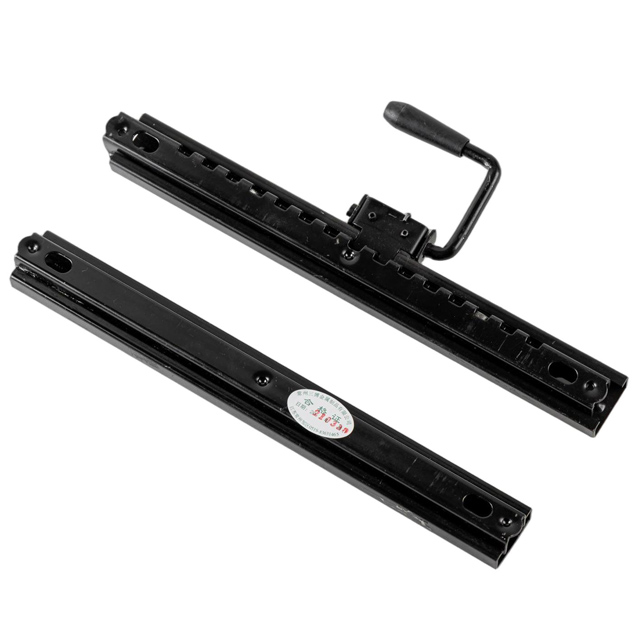
A seat slider is a short pair of rails mounted between the seat mechanism and the seat pan. One rail is fixed to the mechanism or to the underside of the seat frame, the other carries the pan, and rolling elements or low-friction pads sit between them so that the pan travels forward and backward while staying square to the chair. A lock holds the chosen position, and a lever under the front edge of the seat releases it.
Nothing about the motion is new. What has changed is the precision expected of the part. A rail that once offered two positions now offers five, and the difference between a pan that feels solid and one that rocks is measured in fractions of a millimetre of play at the locked position.
The vocabulary is loose. Seat slide, seat track, seat rail, seat depth adjustment and seat slider describe the same hardware, and a specification written with one term is often answered with a drawing labelled with another. Vehicle work usually calls the part a seat track. Office furniture catalogues call it a sliding seat or a depth adjustment. In a chair specification, seat slider is the term that identifies the rails rather than the upholstery above them.
Three Adjustments, Three Different Mechanisms
Height is set by the gas spring or the column beneath the mechanism, and it raises or lowers the whole seat.
Back angle is set by the recliner, a geared or toothed joint at the rear of the mechanism.
Seat depth is set by the seat slider, which moves the pan alone and leaves the backrest where it is.
Confusing the last two is the most common error in a chair brief. A chair described as having an adjustable seat usually adjusts height, back angle and depth through three separate mechanisms, and only the third one changes the distance from the front edge of the pan to the backrest.
Why a Chair Needs One: The Fit Problem
Seat depth is the distance from the front edge of the pan to the backrest, and the right value depends on the length of the user's thigh rather than on the size of the chair. A pan that is too long presses behind the knee, restricts circulation and pushes the pelvis forward into a slouched position. A pan that is too short leaves the thighs unsupported and concentrates pressure under the sit bones.
Adults differ in leg length by well over 100 mm, so a fixed pan is a compromise that suits the middle of the range and nobody at the ends. The field test used by ergonomists is the gap behind the knee: two to three fingers of clearance between the front edge of the pan and the back of the calf when the back is against the backrest. Without a seat slider, that gap is whatever the chair happens to give.
Standards treat the adjustment as part of the chair rather than an accessory. The European standards body that publishes the EN 1335 office chair series defines dimension ranges for work chairs, including the seat, and measures them under stated conditions, which means a chair is expected to reach a range rather than a single value. Workplace guidance points the same way: assessment guidance for display screen work treats the chair as furniture that is adjusted to the person using it, not the reverse.
Two further cases push the requirement harder. Shared seating and hot-desking put several body sizes on one chair in a single day, and a reclined posture changes the effective depth because the pelvis rotates and the thighs lift. A slider with five positions handles both better than a longer pan does.
The Four Ways a Chair Seat Slider Is Built
Four constructions account for most of the volume in this class. They differ in friction, in the amount of play left when locked, and in how the part behaves after several years of use.
The Caged Ball Seat Slider
Caged ball construction runs hardened steel balls in a formed race, with a cage keeping the balls evenly spaced. Load is shared across many contact points, friction is low, and play at the locked position can be held to a few hundredths of a millimetre. The penalty is sensitivity: grit that reaches the race turns a smooth travel into a notchy one, and a dried lubricant film has the same effect. Vehicle seats and high-end task chairs use this construction because it combines a light release force with a pan that does not move once locked.
Roller and Polymer Glide Slides
Roller slides replace the balls with nylon or steel rollers; glide slides replace them with polyoxymethylene pads running on steel. Both have fewer parts, cost less and tolerate dust, lint and crumbs far better than a ball race. The trade is friction and play: a roller slide is noticeably freer at the start of its travel and noticeably looser when locked, and a polymer glide can stick and release in steps at slow speed. They suit contract chairs, benches and seating that is adjusted a few times a day rather than continuously.
Integrated Mechanism Slides
On many task chairs the rails are built into the tilt mechanism housing, with the release lever under the front of the seat and travel of around 50 mm in five steps. The arrangement is compact, protects the rails from dust and simplifies assembly, because the mechanism and slider arrive as one unit. Service is the weak point: a worn slider means replacing the mechanism rather than the rails, and the two share a single warranty claim.
Long Travel and Telescopic Slides
Where the chair has to be entered from the side, or where the occupant reclines close to horizontal, a multi-stage ball slide extends travel to 200 mm or more. Recliners, medical and dental seating and some auditorium benches use this construction. It costs height under the pan, which has to be designed into the seat rather than added afterwards.
Specifying a Seat Slider for a Chair Programme?
Send the pan envelope, the mounting interface and the required travel, and the reply is a rail specification with matching drawings.
How the Lock Works, and Why Backlash Matters
The lock is what turns a sliding pan into a seat. Three arrangements are common. A friction clamp pinches the rail and holds at any point. A positive lock drops a spring-loaded pawl into slots or holes, so the seat indexes in defined steps. A cam or over-centre clamp multiplies hand force into a short, firm throw. The first is stepless and cheap, the second carries far more load, and the third gives the crisp feel that buyers associate with a well-made chair.
Backlash is the movement a locked seat slider allows before the lock takes load, and it is the number that separates a pan that feels solid from one that knocks. It is measured by pushing the pan forward and backward with the lock engaged and reading the movement at the front edge. A few tenths of a millimetre is normal in a ball rail. A millimetre or more is felt under the thigh at every weight shift, and it is the complaint that starts most warranty conversations.
Actuation matters as much as the lock itself. A single lever that releases both rails at once keeps the pan square. A design that releases one rail before the other lets the seat skew, and the user learns to straighten the pan by hand. Cable release solves the reach problem on deep pans and on chairs with a closed outer shell, at the cost of one more adjustment during assembly.
The lock also carries a safety role. A slider that releases under load drops the user forward without warning, which is why a positive lock rather than friction alone is the usual choice for institutional and public seating. The release force belongs in the specification too: light enough for a seated user to operate with one hand, firm enough that a hip or a bag does not trigger it.
Seat Slider vs Vehicle Seat Slider: Same Motion, Different Duty
The rails under a car seat and the rails under a chair look like relatives, and mechanically they are: both are pairs of roll-formed steel channels with a carriage between them and a lock that indexes position. The duty they carry is different, and so is the evidence a buyer should ask for.
A vehicle seat slider carries the seat, the occupant and, in a crash, the belt loads. The federal seating strength requirement applies a forward and a rearward force of 20 times the weight of the seat at any position of adjustment, and the seat has to stay in that position while the load is applied. That requirement is what makes a vehicle rail heavy: thicker gauge, a positive lock with a return spring, and a release that cannot be knocked open by a foot.
A chair slider works to a different brief. The chair standards describe use by adults up to 110 kg across a full working day, with cyclic durability of the seat, back and mechanism rather than a single crash load. Quiet operation, low release force and a pan that stays level when the user shifts weight matter more than ultimate strength, and weight is a cost rather than a safety margin.
That is why the two are not interchangeable in either direction. A chair rail taken into a vehicle has no crash evidence behind it, and its lock is designed for a hand rather than for a belt load. A vehicle rail taken into a chair arrives overbuilt, several times heavier than the application needs, with a detent loud enough to be heard across an open office.
The same manufacturing base serves both, and usually does. Roll forming, stamping, welding and electrocoating are shared processes, so seat sliders built for vehicle seating and the mechanisms behind gaming chair adjusters come off the same type of press line with different gauges, locks and finishes.
What Goes Wrong, and What Each Symptom Means
Most faults fall into six patterns, and each one points at a different cause.
Lateral play. The pan rocks side to side when locked. Worn ball cage or glide pads are the usual cause; loose fasteners produce the same movement and are checked first, because they are free to fix.
Stick-slip. The pan moves in steps instead of sliding. Dried lubricant, dust in an open rail or light corrosion on the race all produce it, and cleaning usually restores the travel.
Skew and jam. One rail releases before the other, so the seat twists. The cause is an unbalanced release mechanism or a bracket that has been bent during fitting or transport.
Brinelling. Travel feels notchy at fixed intervals. The race has been dented where the balls rest, usually by a static overload or by impact while the seat was locked, and the rail is replaced rather than cleaned.
Rattle. Noise without movement. A weak detent spring, a hardened bumper or a missing end stop is responsible, and the part is a wear item rather than a structural failure.
Corrosion. Rough travel and staining, worst in humid climates and where the chair is cleaned with aggressive agents. Electrocoating resists it better than a thin zinc film, and stainless is reserved for wash-down environments.
Two of the six can be settled by cleaning or by tightening a fastener; the other four point to a part that has to be replaced, which is worth knowing before a chair programme commits to a service policy.
How to Specify a Seat Slider for a Chair
A brief that specifies a seat slider by photograph receives a part that matches the picture and not the chair. Seven questions cover what the supplier needs and what the buyer should be able to answer before a quotation is meaningful.
Load per user and per rail. Design mass, plus the dynamic factor the test standard applies, divided between two rails.
Travel and number of positions. 50 mm in five steps covers most office seating; a longer range is needed where the chair serves several body sizes.
Envelope. Rail length, stack height, mounting hole pitch and the interface to the pan. A rail that fits the pan but not the mechanism is the most expensive kind of error.
Actuation. A lever under the seat front, a side paddle or a cable release, and the hand force each requires.
Backlash and lock type. The permitted movement at the locked position, stated in millimetres, and whether the lock is friction, detent or cam.
Finish and cleaning regime. Electrocoat, zinc plating or stainless, chosen against the cleaning agents the chair will meet.
Evidence. A test report against EN 1335-2 for a work chair, or EN 16139 for contract seating, with the edition and the cycle counts stated.
The parts next to the slider belong in the same conversation. The seat adjusters that set back angle and height share the mechanism housing, and a change to one usually moves the mounting points of the other.
The three slider assemblies below come from a vehicle seating programme, and they are shown because their published dimensions make the construction differences concrete: pitch, hole size, stroke and lock count are all stated per model.

C-Type Double Lock Seat Slider (SBH-007)
Steel C-channel rails with locking on both tracks, 290 × 310 mm pitch, 8.2 mm holes, 150 mm stroke and black electrocoat finish.
View Product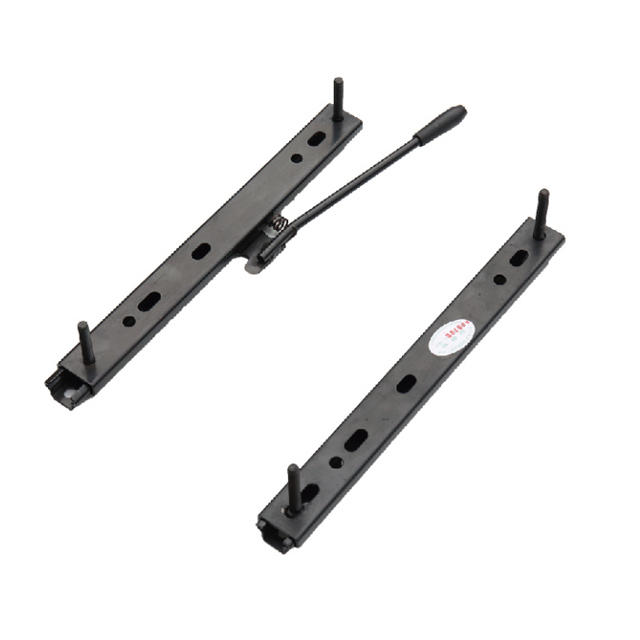
Ballless Seat Slide Rails (SBH-004)
Single-lock rail pair without ball bearings, 290 × 290 mm pitch, 8.2 mm holes, 176 mm stroke and black electrocoat finish.
View Product
Double Lock Slider with Welded Bracket (SBH-005)
Welded and riveted bracket version, 320 × 400 mm pitch, 8.2 mm holes, 210 mm stroke and black electrocoat finish.
View ProductFitting and Keeping a Seat Slider Working
Fitting decides more of the outcome than the part does. The two rails have to be parallel and level, because a pair that is twisted will bind at one end of its travel and feel loose at the other. Fasteners are torqued to the mechanism maker's figure rather than to feel, since a bolt that is tight but not torqued frets against its seat. The pan is positioned so that the two to three finger gap falls inside the available travel, and the release lever sits where a seated user can reach it without lifting a hip.
Maintenance is short. Debris in an open rail is the usual cause of a stiff action, and a dry brush or a vacuum removes it. Solvent cleaners strip the film from polymer glides and leave them squeaking, while silicone spray attracts dust and turns into a paste that collects more of it. An annual check of lateral play and lock engagement catches wear while the part is still serviceable.
Seat Slider Constructions Compared
| Type of seat slider (by construction) | Typical travel | Play when locked | Lock arrangement | Suited to |
|---|---|---|---|---|
| Caged ball bearing | 50 mm to 100 mm | Minimal, fractions of a millimetre | Detent or friction | Task chairs, vehicle seats, high-cycle use |
| Roller slide | 50 mm to 100 mm | Noticeable | Friction or detent | Contract chairs, benches, meeting seating |
| Polymer glide | 30 mm to 80 mm | Highest of the four | Friction clamp | Entry-level task chairs, occasional adjustment |
| Integrated mechanism slide | About 50 mm | Low | Multi-step pawl | Task chairs with a synchro mechanism |
| Telescopic multi-stage | 200 mm and above | Low | Lever with brake | Recliners, medical and dental seating |
Comparing Seat Slider Constructions for a New Chair?
Rail gauge, lock count and stroke decide fitment more often than travel does, and each is published per model.
Conclusion
A seat slider is a small assembly with an outsized effect on whether a chair fits the person sitting in it. Three points decide the outcome: the construction sets the feel and the play, the lock sets the safety and the noise, and the test evidence sets whether the part is qualified for the duty it will see. A chair programme that treats those three as one decision avoids the familiar sequence of a sample that feels right, a production run that rattles and a warranty claim that cannot be traced to a drawing.
For readers comparing seat slider manufacturers, SANBO provides published specifications, technical documentation and direct inquiry channels for further evaluation.
FAQ
Is a seat slider the same as seat depth adjustment?
Yes in function, no in hardware. Seat depth adjustment is the result, and the seat slider is the pair of rails that produces it. A few chairs reach the same result by moving the backrest forward on its mount instead, which changes the angle between seat and back as it moves and is a different compromise.
Do all office chairs have a seat slider?
No. Task chairs above entry level usually include one, while guest chairs, meeting chairs and side seating rarely do because they are occupied briefly and by many people in turn. The feature is most common where the same chair is used for a full working day.
How much seat slider travel is enough?
Around 50 mm in five steps covers most of the adult population on a single-user chair. A shared chair or a specification that includes tall users is better served by 60 mm to 100 mm, because the extra range is used at both ends of the body size distribution rather than in the middle.
Can a seat slider be added to a chair that lacks one?
Rarely. The rails are designed into the mechanism or the pan interface, so retrofitting means replacing the mechanism, and the mounting pattern of the replacement has to match the column and the base. A chair sold without the adjustment is usually built on a mechanism that has no provision for it.
Why does the seat move when the user leans forward?
Three causes are common: the lock was not fully engaged after the last adjustment, the detent spring has weakened, or a friction clamp has polished the rail and lost its grip. The first is a habit, the second is a wear item, and the third is a replacement decision once the clamp can no longer hold a loaded pan.
References and Notes
European Committee for Standardization — publisher of the EN 1335 office work chair series (dimensions, safety requirements, test methods) and the EN 16139 non-domestic seating standard (cen.eu, accessed 2026-11-18)
Workstation assessment guidance for display screen work — the chair is assessed as part of the furniture and adjusted to the user (hse.gov.uk, accessed 2026-11-18)
Federal seating system strength requirements — 20 times the seat weight applied at any position of adjustment (ecfr.gov, accessed 2026-11-18)
Data notes: travel figures in the comparison table are typical published ranges across chair ranges rather than values fixed by a standard, and 50 mm in five steps is the most common office chair specification. The EN 1335-2 scope of use by adults up to 110 kg over a full working day, and the exclusion of seat height and tilt mechanism durability from the EN 16139 scope, follow published summaries of both standards; the edition cited in a test report should be checked against the project requirement. The 290 × 310 mm, 290 × 290 mm and 320 × 400 mm pitches, the 8.2 mm hole size and the 150 mm, 176 mm and 210 mm strokes are the manufacturer's published figures for the three models shown.